

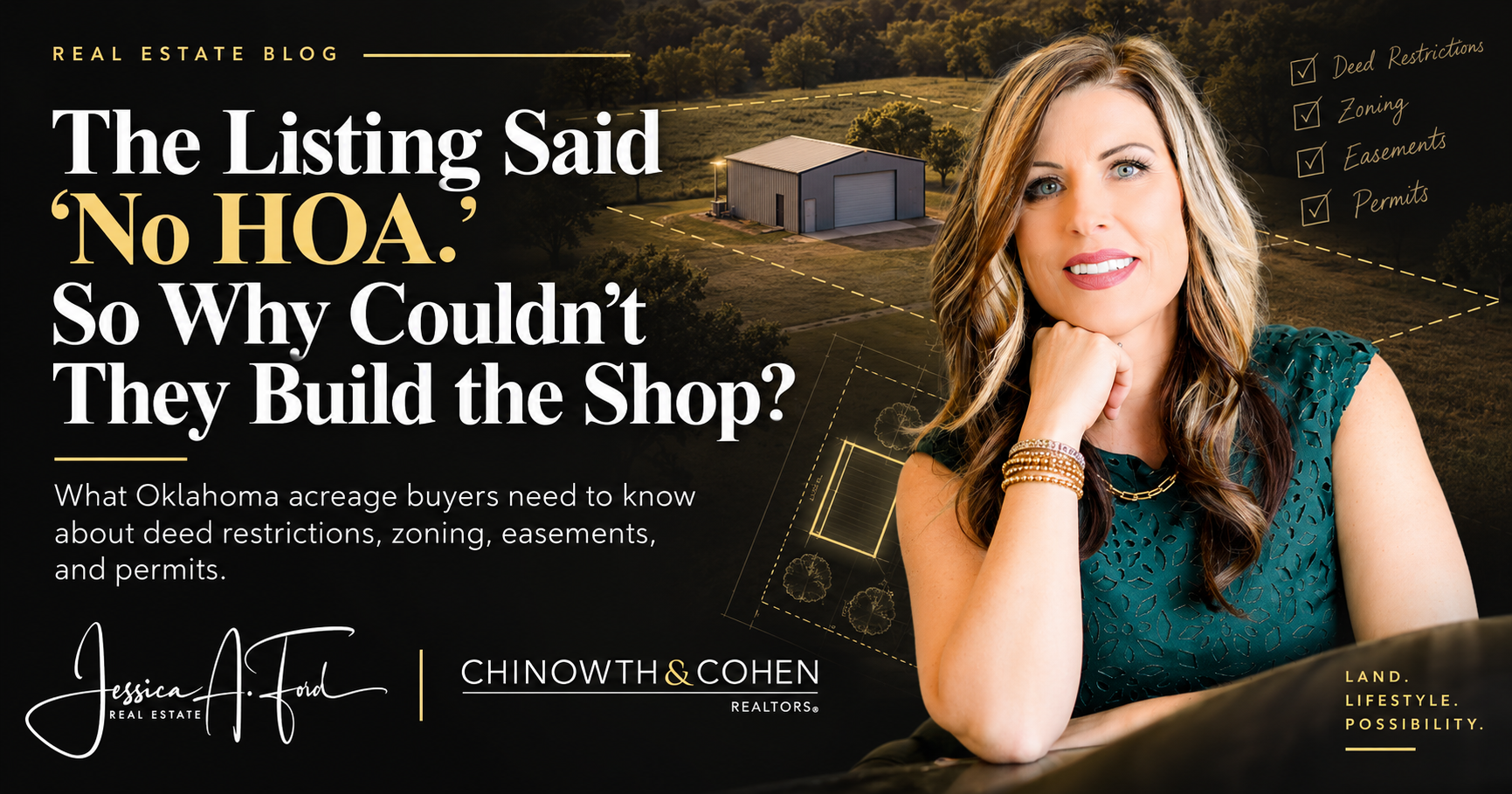
The Listing Said “No HOA.” So Why Couldn’t They Build the Shop?
Quick Answer: Does “No HOA” Mean There Are No Restrictions on Oklahoma Property?
No. A property can have no active homeowners association and no monthly HOA dues and still be affected by recorded restrictive covenants, deed restrictions, easements, setbacks, building lines, zoning regulations, and permitting requirements.
That distinction is especially important when someone is buying Oklahoma acreage because they want to build a shop, barn, detached garage, RV building, pool house, second residence, or another improvement after closing. The current Tulsa County Zoning Code specifically recognizes that private easements, covenants, deed restrictions, and other agreements can exist separately from county zoning regulations. It also states that Tulsa County is not responsible for monitoring or enforcing private agreements between property owners.
So when an acreage listing says “No HOA,” that answers one question. It does not necessarily answer the one that may matter more:
Can I actually use this property for the reason I’m buying it?
Why “No HOA” Can Sound Like Complete Freedom
For an acreage buyer, those two words can be incredibly appealing.
If you have spent years living in a neighborhood where an association regulates fences, exterior colors, detached buildings, trailers, or where an RV can be parked, “no HOA” can sound like freedom. You walk five or ten acres outside Tulsa and immediately begin imagining what you could do with all that space.
Maybe you want a 2,400-square-foot shop for your truck, trailer, tools, and side-by-side. Maybe you want horses and eventually a barn. Maybe the entire reason you are leaving a traditional subdivision is to have room for an RV building, pool house, detached garage, arena, or home-based business.
The problem is not wanting those things. The problem is assuming that because there is no HOA, there are no other restrictions.
An HOA is an organization. A restrictive covenant or deed restriction is a private limitation affecting real property. Zoning is governmental regulation. Easements create rights involving another person, company, or governmental entity. Setbacks and building lines may affect where improvements can be located.
Several of those can apply to the same property at the same time.
An acreage development may have restrictions that were recorded when the property was originally divided, even though there is no active association collecting dues today. Depending on the documents, those restrictions could address detached structures, minimum home sizes, animals, commercial uses, building locations, or other uses of the land.
That does not mean every old restriction automatically remains enforceable forever. The meaning, duration, amendment, and enforceability of a particular covenant can become a legal question. But there is a much simpler lesson for a buyer:
No HOA does not prove there are no recorded restrictions.
Tulsa County's zoning code makes that distinction directly. County zoning does not automatically eliminate an easement, covenant, deed restriction, or other agreement between private parties. If county zoning imposes the greater restriction, the zoning regulation controls to that extent.
That means the shop you are planning could satisfy the applicable zoning rules and still raise a separate issue under a private restriction. Or the private documents might not prohibit the shop while zoning creates additional limitations.
Suddenly, “Can I build a shop?” is not one question anymore.
When the Future Plan Is the Reason You Are Buying
This is where acreage due diligence needs to look different from a traditional home purchase.
When someone buys a home in a subdivision, much of the inspection conversation naturally centers on the house that already exists. How old is the roof? Is the HVAC functioning? Is the foundation sound? Are there plumbing or electrical problems?
Those things still matter on acreage, but the land itself may be one of the primary reasons for the purchase.
If you are buying seven acres because you want a horse barn, the barn matters. If you are buying ten acres because you need a large workshop, the shop matters. If you plan to store an RV, operate a home-based business, construct another residence someday, build an arena, or potentially divide the land later, those plans deserve attention before closing.
The current 2026 Oklahoma Uniform Contract of Sale of Real Estate, Land With or Without Dwelling specifically identifies “Use of Property” as an area buyers may investigate. It lists property-use restrictions, building restrictions, easements, restrictive covenants, zoning ordinances and regulations, and mandatory homeowners associations and dues. If the investigation period is left blank, the form currently provides 10 days after the Time Reference Date.
That gets directly to the issue.
A buyer should not only ask, “Can I purchase this acreage?” The better question is, “Can I use this acreage for what I intend to do after I own it?”
That is why I would rather have a buyer tell me, “I need five acres because I want to build a 40-by-60 shop,” than simply say, “I want five acres with no HOA.”
The first statement tells us what actually needs to be investigated.
The acreage is the container. The intended use is the goal.
Why the Shop Next Door Doesn't Answer the Question
One of the easiest assumptions to make when looking at acreage is that surrounding properties tell you what your property can do.
You look across the road and see a huge metal shop. The neighbor has horses. Someone two properties down has an RV building. Another owner has a large barn behind the house.
It is natural to think, “They have one, so I can build one too.”
Maybe you can, but the neighboring structure does not automatically establish your rights.
That building might have been constructed decades ago. The neighboring parcel could have different zoning, different acreage, different recorded restrictions, or an entirely different legal history. There may have been a variance or other approval. Their tract may not even have originated from the same subdivision of land.
Two properties can look almost identical from the road and be very different on paper.
The better question is not whether your neighbor has a shop. It is whether your particular property can accommodate the shop you plan to build.
Zoning is part of that answer. For property inside Tulsa city limits, the City of Tulsa Development Services Department reviews projects for compliance with applicable building and zoning codes. Depending on the project, its review can also involve water, sewer, drainage, floodplain, and other issues.
Jurisdiction therefore matters. A property can have “Tulsa” in its mailing address without necessarily being located inside Tulsa city limits, so buyers need to determine which governmental authority actually regulates the property.
For property that is within the City, the Tulsa Zoning Code contains specific regulations affecting accessory structures, including size, height, and setback provisions that vary by zoning district.
The City also notes that some improvements that do not require a full building permit may still require zoning clearance. Its current guidance, for example, identifies garages among accessory-use permit categories and lists certain accessory buildings under 200 square feet among projects that can require zoning-clearance review.
Owning the land therefore does not automatically answer what can be built on it.
The Empty Part of the Yard May Not Be the Buildable Part
Another surprise can come after a buyer has already decided exactly where the future building should go.
You are standing on ten acres looking at a large, flat opening beside the house. It seems perfect for the shop. Then you begin reviewing the survey and title documents.
There may be a utility easement running through part of that area. A platted building line may affect another section. Setback requirements can reduce the available footprint. A septic system or reserve area may occupy part of the location. Drainage, terrain, or floodplain considerations may change what is practical.
None of those things automatically mean the property does not work. They mean the site needs to be evaluated based on the actual property rather than simply on what looks empty when you are standing in the yard.
The Oklahoma land contract recognizes this issue too. In addition to listing easements and building restrictions as matters buyers may investigate, the current form provides for title evidence and gives the parties options regarding a survey.
This connects to something acreage buyers should understand early:
Total acreage, usable acreage, and buildable acreage are not necessarily the same thing.
A ten-acre property with the wrong limitations for your plans may work worse for your family than a five-acre property where the intended use has already been investigated.
That is why the goal should not simply be finding the largest number of acres within your budget.
The goal is finding land that supports the life you intend to create there.
What I Would Investigate Before Buying Acreage for a Specific Purpose
If a future improvement is one of the primary reasons you are buying a property, I would make that improvement part of the due-diligence conversation before closing.
For a shop, barn, RV building, arena, detached garage, second residence, pool house, home business, or another significant use, I would want to know which governmental jurisdiction controls the property and how it is zoned. I would also want to know whether recorded restrictive covenants exist, whether there are easements or building lines near the proposed construction area, whether setbacks or size limitations affect the project, and what permits or approvals may be required.
A survey may become particularly important when the proposed location matters. If a recorded restriction contains language that could materially affect the reason you are buying the property, that is also an appropriate time to ask a title professional or Oklahoma real estate attorney to evaluate it rather than guessing about what the document means.
A Realtor can help identify these questions, gather information, and make sure they are raised early. But determining whether a particular covenant is legally enforceable or interpreting complicated title language belongs with the appropriate legal or title professional.
I would also be cautious about relying on statements such as, “The neighbors all have shops,” “Nobody enforces that anymore,” “There hasn't been an HOA for years,” or “It's acreage, so you can pretty much do whatever you want.”
Those statements may sound reassuring.
They are not substitutes for property-specific due diligence.
No HOA Can Still Be Exactly What You Want
None of this means “no HOA” is meaningless or that buyers should avoid properties without an association.
For many acreage buyers, having no mandatory HOA is one of the biggest advantages. It may mean no mandatory association dues, no HOA board, and no HOA architectural-review process.
That can create significantly more flexibility.
But greater flexibility is not the same thing as unlimited use.
Private covenants, governmental zoning, easements, setbacks, building codes, and permitting requirements can all exist independently of an HOA.
That is why serious acreage buyers should move beyond one simple question.
Instead of asking only, “Is there an HOA?” ask:
“Are there any restrictions, easements, zoning rules, or other requirements that could affect what I plan to do with this property?”
That gets much closer to the answer you actually need.
Frequently Asked Questions About No-HOA Property in Oklahoma
Can an Oklahoma property have deed restrictions without an HOA?
Yes. Private restrictive covenants and deed restrictions can exist separately from an active homeowners association. The Tulsa County Zoning Code expressly recognizes easements, covenants, deed restrictions, and other private agreements independently of county zoning regulations.
Does “no HOA” mean I can build anything I want?
No. Zoning regulations, restrictive covenants, easements, setbacks, building lines, building codes, and permitting requirements may still affect what can be constructed and how a property can be used.
Can Tulsa County enforce private deed restrictions?
Tulsa County says it is not responsible for monitoring or enforcing agreements or covenants between private parties. Whether a particular covenant remains legally enforceable, and who may enforce it, can require legal review.
How do I know if I can build a shop on Tulsa-area acreage?
Start with the exact property. Determine its governmental jurisdiction and zoning, review recorded restrictions and easements, evaluate the proposed building location, and verify applicable permitting requirements. For property inside Tulsa city limits, City of Tulsa Development Services is an authoritative starting point for building and zoning questions.
Should I investigate restrictions before buying acreage?
If your purchase depends on a particular future use, it deserves investigation. The 2026 Oklahoma land contract specifically identifies property-use restrictions, building restrictions, easements, restrictive covenants, zoning regulations, and mandatory HOAs among the matters a buyer may investigate.
“No HOA” Answers Only One Question
A listing that says “No HOA” tells you something valuable. It may tell you there is no mandatory homeowners association governing the property.
But it does not automatically tell you whether you can build the shop, add the horse barn, store the RV, operate the business, construct another residence, install the pool, or place a building exactly where you imagined it during the showing.
Those questions require a closer look at the property itself.
And that is really the lesson:
Do not just investigate the property you are buying. Investigate the life you plan to create on it.
If the reason you are buying acreage is what you want to do there after closing, make sure the property actually supports that plan before the keys are yours.
This article is provided for general educational purposes and is not legal, zoning, title, surveying, engineering, permitting, or financial advice. Property restrictions and development requirements vary based on location, jurisdiction, zoning, recorded documents, physical characteristics, and intended use. Buyers and property owners should consult the appropriate governmental agencies and qualified title, surveying, legal, and other professionals regarding a specific property.
