

If you are relocating to Tulsa from the Midwest, Colorado, the Northeast, or another part of the country where basements are common, one of the first things you may notice while touring homes is what is missing.
Where are all the basements?
It seems especially strange in Oklahoma. Severe thunderstorms and tornado warnings are familiar here, yet full residential basements are relatively uncommon throughout Tulsa, Broken Arrow, Bixby, Jenks, Owasso, and much of Green Country.
Instead, buyers are more likely to find an in-ground shelter built into the garage floor, a reinforced above-ground safe room, or another dedicated storm shelter.
Tornado risk alone does not explain why Tulsa homes developed this way. Soil, geology, drainage, foundation design, construction practices, and cost all play a role. And a properly designed safe room does not have to be underground to provide serious tornado protection.
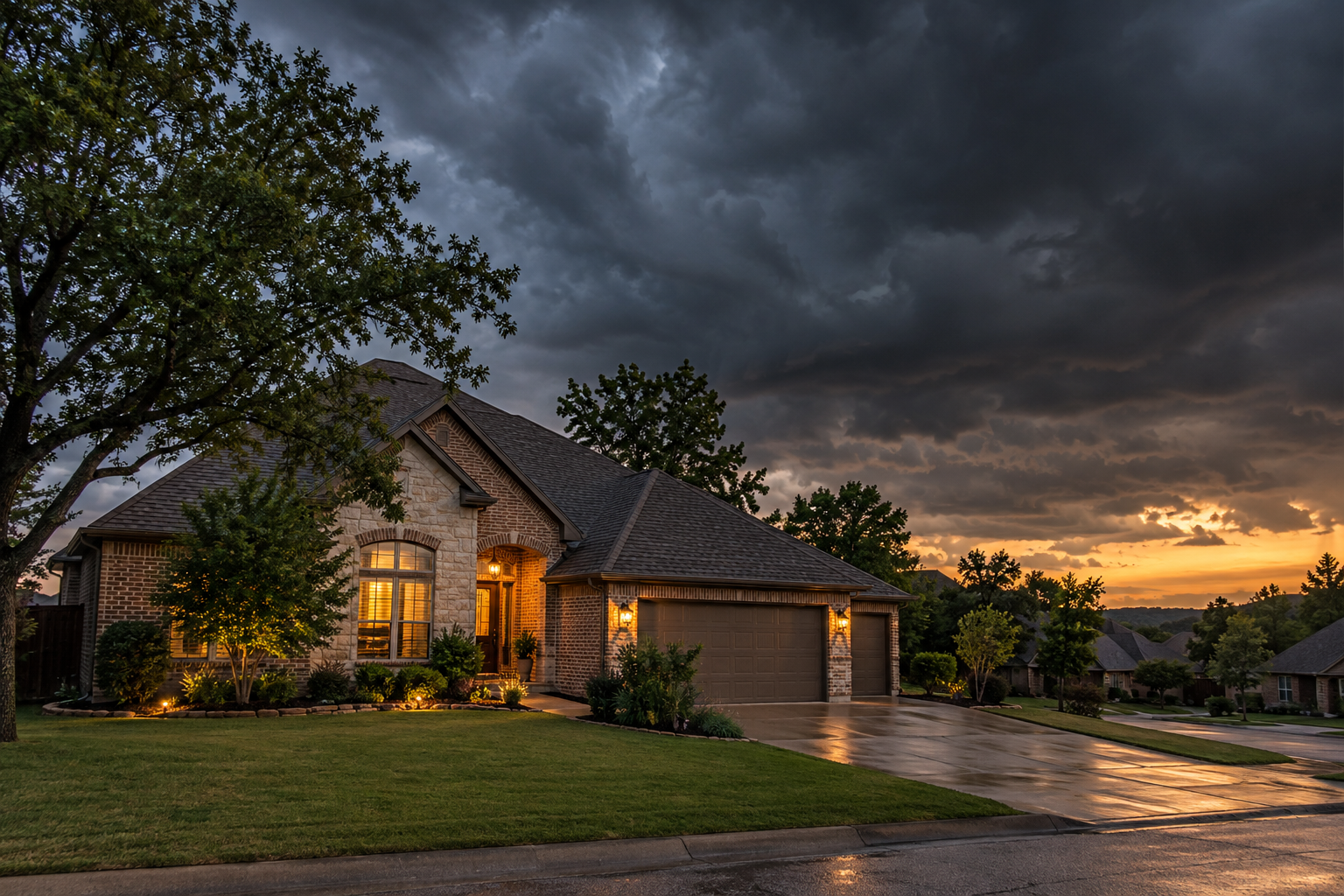
Quick Answer: Why Don’t More Tulsa Homes Have Basements?
Basements are possible in Oklahoma. They simply have not become the standard residential foundation system they are in many colder parts of the country.
Tulsa-area construction has to account for clay-rich soils, shale, sandstone, limestone, drainage, and flood risk that vary by property. The City of Tulsa identifies expansive soils as a local hazard and notes that portions of the city have moderate to high shrink-swell potential.
If you read my guide to Tulsa foundation cracking and expansive clay, you already know how much moisture management can matter around a foundation. Moving walls several feet below grade adds more excavation, waterproofing, structural engineering, and drainage considerations.
That does not make basements impossible. It helps explain why they are less common and why many Oklahoma homeowners use a smaller purpose-built shelter instead.
Tulsa’s Ground Is Part of the Basement Story
One of the biggest misconceptions is that Oklahoma builders avoid basements simply because they do not want to build them. The ground itself is part of the equation.
Geologic mapping around Tulsa shows clay shale, sandstone, limestone, alluvial deposits, and other formations depending on the location. The Oklahoma Geological Survey provides detailed mapping for the Tulsa area.
Excavating below grade can introduce site-specific challenges. A builder may encounter expansive soil requiring additional engineering, harder rock that complicates excavation, or groundwater and drainage conditions that increase waterproofing requirements.
That is why blanket statements such as “Tulsa has too much rock for basements” or “Oklahoma clay makes basements impossible” are misleading. Two nearby properties may have very different soil, elevation, drainage, and underlying geology.
The better explanation is that basement construction in Green Country can require additional engineering and expense without being necessary for the way most homes here are built.
A Basement and a Tornado Safe Room Are Not the Same Thing
Having a basement does not automatically mean you have a FEMA-compliant tornado safe room.
The City of Tulsa Storm Shelter Registry states that a basement must be certified by an engineer before it can be considered a safe room for registration purposes.
FEMA guidance goes much further than simply telling homeowners to get below ground. A safe room is a hardened space designed to resist extreme wind pressures and wind-borne debris even if the surrounding structure is badly damaged.
According to FEMA’s Taking Shelter From the Storm guidance, a properly designed above-ground safe room can provide the same level of life-safety protection as an in-ground safe room when it meets applicable criteria.
For relocating buyers, that distinction is important: underground is not automatically the only safe option.
In-Ground Garage Shelters
One of the most recognizable options in the Tulsa metro is an in-ground shelter installed into the garage floor. It typically preserves usable garage space while keeping the shelter close to the living area.
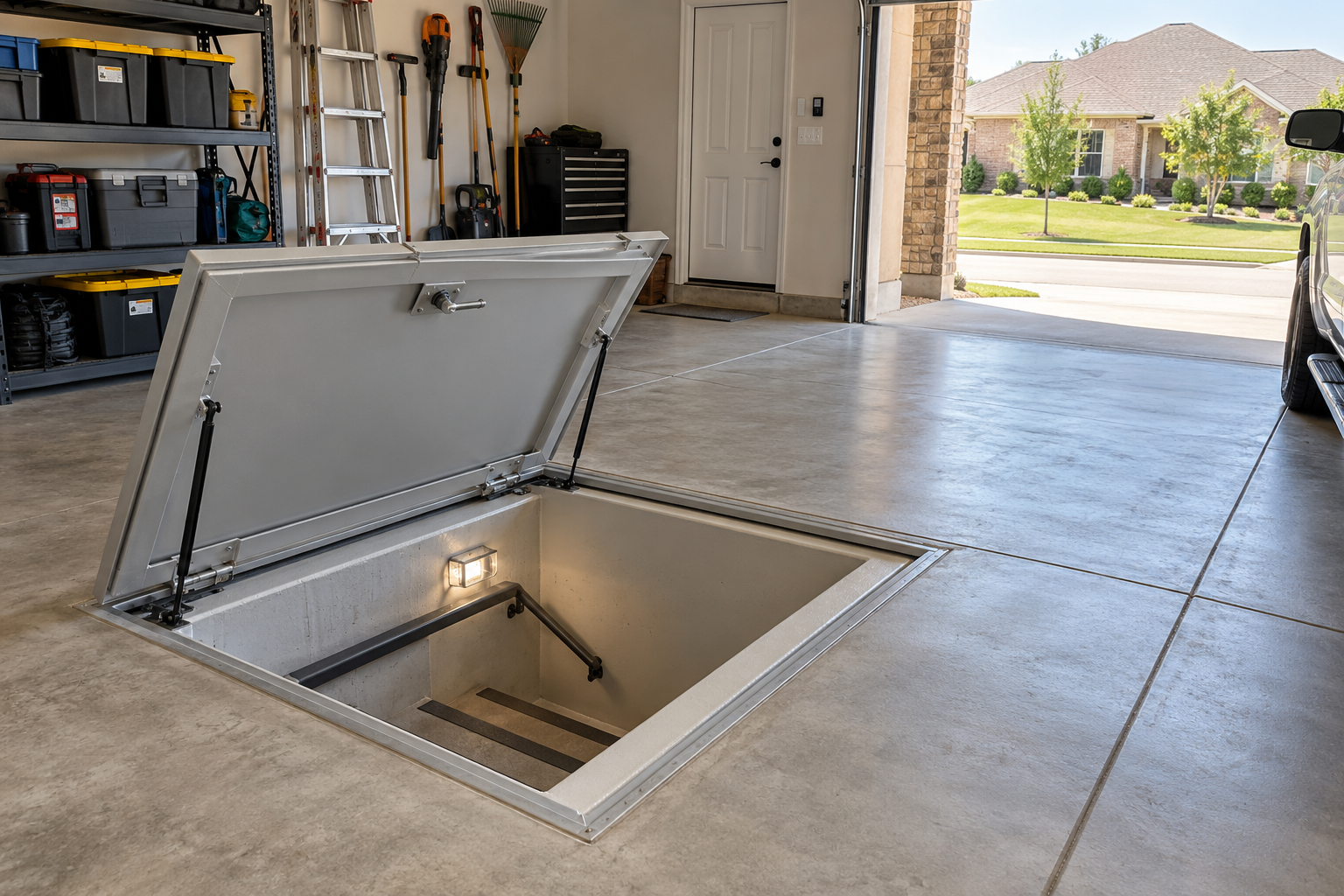
The tradeoffs are accessibility and water management. Entry usually requires steps, which can be difficult for older adults or people with mobility limitations. FEMA recommends considering the needs of everyone who may have to enter the shelter quickly.
FEMA also recommends directing stormwater away from below-grade shelter entrances and considering groundwater and flood hazards before choosing an in-ground location. That matters in Tulsa because the same storm system can bring tornado warnings and flash flooding.
Above-Ground Safe Rooms Have Changed the Conversation
Some buyers arrive in Oklahoma convinced that the only safe place during a violent tornado is underground. Modern safe-room engineering has changed that.
FEMA recognizes properly designed above-ground safe rooms as a life-safety option. Current FEMA criteria for federally funded residential tornado safe rooms use a 250 mph design wind speed, with components designed and tested for extreme wind and debris conditions.
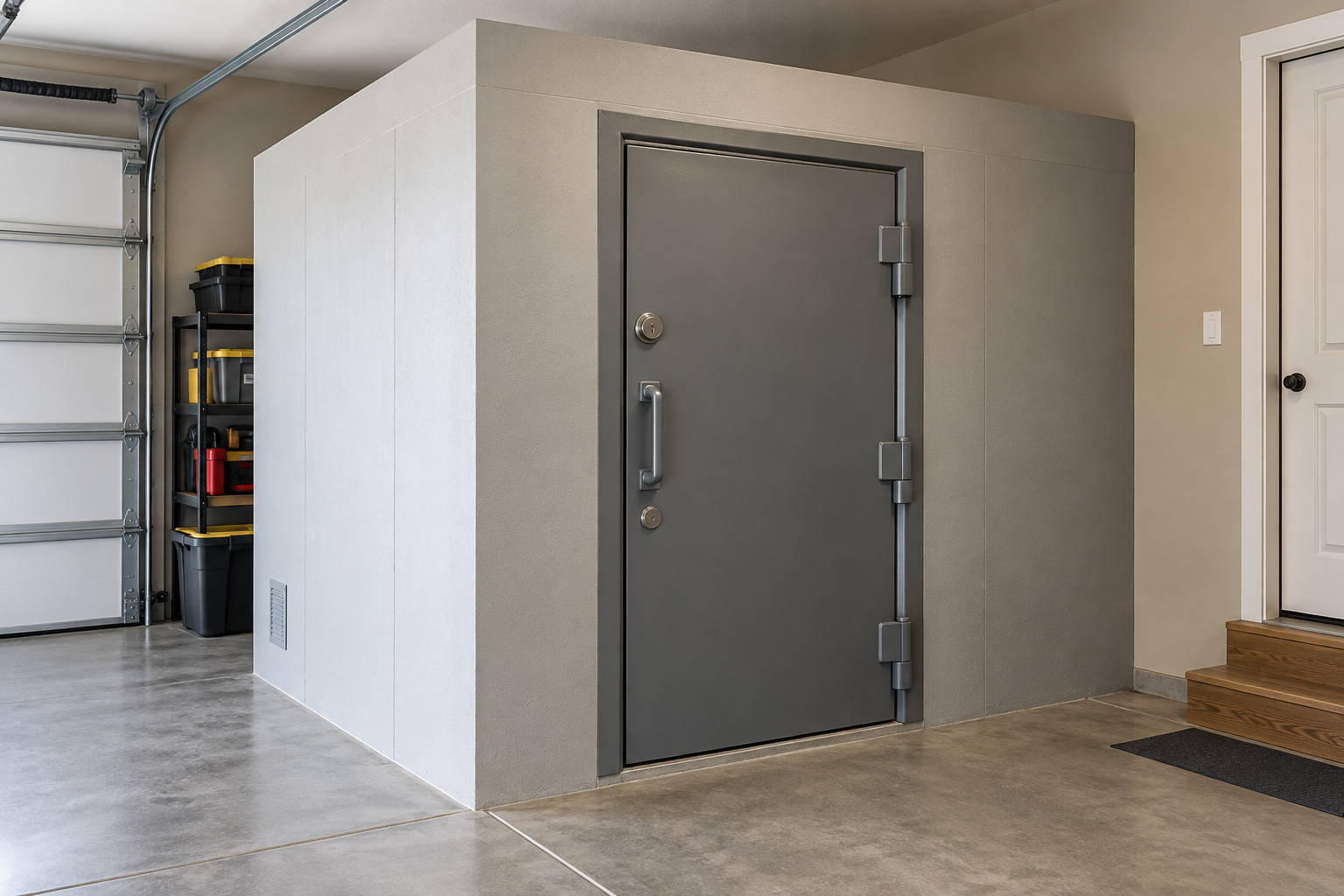
Above-ground rooms can also be easier to access. Instead of climbing down into a shelter, occupants can walk directly into a reinforced space located in a garage, interior area, or incorporated into new construction.
One caution: do not rely solely on phrases such as “FEMA certified.” FEMA does not individually certify shelter products. What matters is whether the design, anchoring, components, construction, and installation comply with the applicable standards.
If a home already has a safe room, I would want any available documentation for the manufacturer, model, installation, testing or compliance, and permits.
In-Ground or Above-Ground: Which Is Better?
There is no single answer for every household.
| Consideration | In-Ground Shelter | Above-Ground Safe Room |
|---|---|---|
| Floor space | Usually preserves garage floor space | Uses some garage, closet, utility, or interior floor space |
| Entry | Typically requires steps down | Can provide level entry |
| Mobility | May be difficult for some occupants | Often easier for children, pets, wheelchairs, or walkers |
| Flood and groundwater | Requires careful consideration | Can be preferable where below-grade flooding is a concern |
| Tornado protection | Can provide high protection when properly designed and installed | Can provide equivalent protection when properly designed and installed |
| Existing home installation | Common garage retrofit option | Can also be installed in existing homes, subject to foundation and anchoring requirements |
The right choice depends on the property and the people using it. For families with young children, older parents, pets, or mobility limitations, ease of entry may matter just as much as whether the shelter is above or below ground.
Flood Risk Belongs in the Storm-Shelter Conversation
A storm shelter is intended to protect you from one hazard. Its location should not unnecessarily expose you to another.
FEMA recommends evaluating flood risk before locating a residential safe room and consulting local floodplain officials because local requirements can be more restrictive.
Tulsa also requires a building permit for safe rooms installed within city limits and advises homeowners to consider flood hazards for above-ground and below-ground locations.
That is why drainage, property elevation, groundwater, floodplain status, and access should be considered alongside tornado protection.
Register the Shelter After It Is Installed
The City of Tulsa Storm Shelter Registry allows residents within city limits to provide shelter-location information to emergency responders. If debris blocks an entrance after a tornado, that information can help responders locate the shelter.
Broken Arrow has its own Storm Shelter Registration, and Bixby offers a voluntary Severe Weather Shelter Registration Program.
If you live elsewhere, check with your city or county emergency-management office. When buying a home with an existing shelter, also ask whether the registration needs to be updated for the new owner.
Cost and Oklahoma’s SoonerSafe Rebate
Storm-shelter cost varies by type, capacity, location, installation requirements, foundation, and site conditions. The Oklahoma Department of Emergency Management currently cites construction-industry estimates of about $3,000 to $8,000 or more.
Oklahoma homeowners may also hear about the SoonerSafe Safe Room Rebate Program. When funding is available and requirements are met, the program can provide up to 75 percent of the safe-room cost, with a maximum rebate of $3,000 per home.
Homeowners generally need to follow the program’s selection and approval process before installation. As of October 2026, the Oklahoma Department of Emergency Management says the 2026 program is not currently open, so homeowners should check the current page before planning around a rebate.
What Should a Relocating Buyer Check?
When touring a Tulsa-area home with a shelter or safe room, I would not stop at, “Great, it has a storm shelter.”
I would want to know what type it is, where it is located, how quickly everyone in the household can access it, whether flooding could affect it, and whether documentation exists showing how it was built or installed.
For an above-ground unit, ask about anchoring and the standard it was designed to meet. For an in-ground garage shelter, pay particular attention to accessibility and water management. And if the house has a basement, do not automatically assume the basement itself qualifies as a safe room.
The best shelter is one your family can reach quickly, safely, and confidently when a warning is issued.
Tulsa Storm Shelter FAQs
Is an above-ground safe room really as safe as an underground shelter?
When properly designed and constructed to applicable criteria, yes. FEMA states that an above-ground safe room meeting its requirements can provide the same level of life-safety protection as an in-ground safe room.
Can an in-ground garage shelter flood?
It can. Drainage, groundwater, and flood risk should be evaluated before installation, and stormwater should be directed away from below-grade entrances.
Do I need a permit for a safe room in Tulsa?
The City of Tulsa says safe rooms installed within city limits require a building permit. Outside Tulsa, check with the jurisdiction that issues permits for the property.
Should I register an existing storm shelter?
Yes. Tulsa, Broken Arrow, Bixby, and other jurisdictions maintain shelter registries that can provide responders with useful location information after a tornado.
Does having a basement mean a home already has a safe room?
No. A basement can provide shelter, but it is not automatically a FEMA-compliant safe room. Tulsa requires engineering certification before a basement can be registered as a safe room.
The Basement Question Is Really a Tulsa Construction Story
For relocating buyers, the absence of basements can initially feel like one of the strangest things about Oklahoma real estate. Once you understand the local construction environment, it begins to make more sense.
Tulsa homes have evolved around our soils, drainage conditions, construction practices, and severe-weather needs. Instead of building an entire below-grade level primarily for storm protection, many homeowners use a smaller space engineered specifically for that purpose.
That may be an in-ground garage shelter, a reinforced above-ground safe room, a purpose-built room incorporated into new construction, or occasionally a properly designed basement safe room.
The important question is not simply whether the shelter is above ground or below it. It is whether it was properly designed, installed, located, and maintained for the people who will actually use it.
For Tulsa-area buyers, that belongs on the home-buying checklist right alongside the roof, HVAC, drainage, foundation, and everything else that matters after the beautiful listing photos are gone.
