

The Driveway Leads to the Property. But Do You Actually Have the Right to Use It?
Picture this: You turn off a rural road outside Coweta, Inola, or Claremore onto a long gravel drive. It crosses open pasture, disappears behind a line of trees, and eventually reaches the house.
Nothing about it looks unusual. The seller uses it. Delivery drivers use it. Maybe several neighbors use part of it too.
So of course the driveway comes with the property, right?
Not necessarily.
If any portion of that drive crosses land owned by someone else, the important question is not simply whether you can physically drive to the house.
It is whether the property has a legally recognized right to keep using that route.
That distinction can affect title, financing, future improvements, and neighbor relationships.
Quick Answer: Do You Need an Easement to Use a Driveway Across Someone Else’s Property in Oklahoma?
If a driveway crosses property you do not own, you should understand the legal basis that allows the property to use that route.
The cleanest situation is often a written, recorded easement granting ingress and egress. But Oklahoma law also recognizes other ways access rights can arise, including easements by necessity and prescriptive easements. Oklahoma also has a statutory private-way-of-necessity process in certain circumstances.
The Oklahoma Supreme Court discussed several of these distinctions in Childers v. Arrowood, a case involving roadway and utility access across neighboring property.
The important distinction for a buyer is simple:
Physical access and legal access are not always the same thing.
A gravel road used for decades may have a perfectly valid recorded easement behind it.
Or it may exist because a former neighbor simply allowed the previous owner to cross.
Those are very different situations.
The Best-Case Scenario: A Clear Recorded Easement
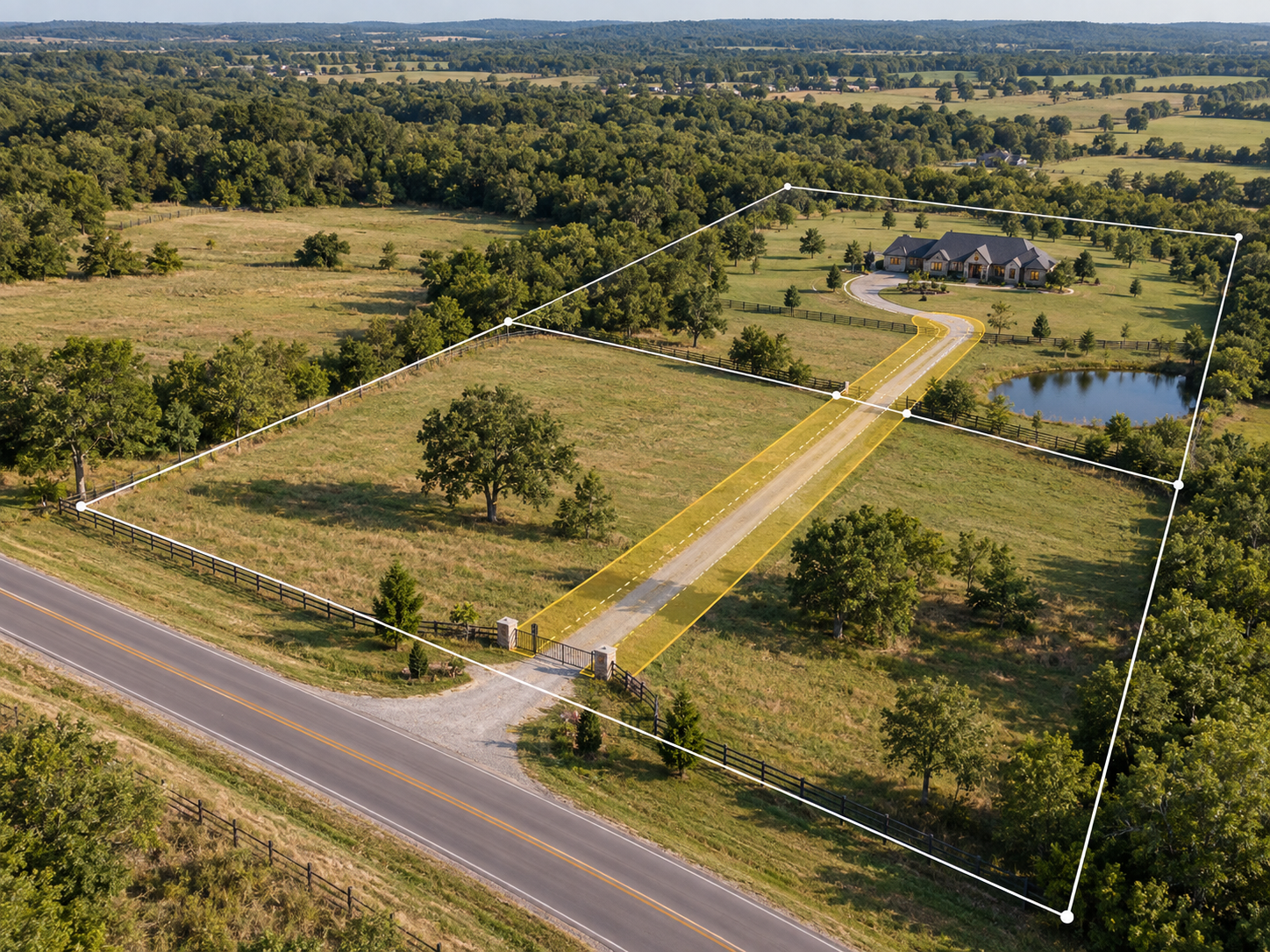
An express easement is generally created in writing and can define who may use the access, where it is located, and what uses are permitted.
For a buyer, the key is not simply hearing:
“Yes, there’s an easement.”
You want to know what the document actually says.
Does it grant ingress and egress? Is it tied to the property being purchased? How wide is it? Does it follow the driveway that is actually being used? Does it address gates, maintenance, utilities, or different types of traffic?
The exact language matters because the scope of an easement may be narrower than a buyer expects.
That became important in Childers v. Arrowood. The property owners already had an express easement for “roadway purposes only,” but they later needed utility access as well. The Oklahoma Supreme Court addressed whether Oklahoma’s statutory private-way-of-necessity law could provide access for utilities necessary for the reasonable use of the property.
The lesson is not that every roadway easement includes utilities.
In that case, the roadway language itself did not.
The lesson is that the wording of the easement matters.
What if There Is No Recorded Easement?
This is where buyers often hear another reassuring statement:
“That’s the only way into the property, so they have to let you use it.”
Oklahoma law is more nuanced.
A common-law easement by necessity generally involves property that was once under common ownership and was later divided in a way that created a need for access.
The Oklahoma Supreme Court summarized those elements in Childers, including prior unity of title, a conveyance separating the property, and a resulting necessity.
That means buying a difficult-to-access tract does not automatically create a common-law easement across whichever neighboring parcel happens to offer the easiest route.
The history of how the properties were divided can matter.
For that reason, a title professional or Oklahoma real estate attorney may need to review the chain of title when there is no clearly recorded access right.
Oklahoma Has Another Option: A Private Way of Necessity
Oklahoma adds another layer that many buyers do not know about.
Under Title 27, Section 6 of the Oklahoma Statutes, certain private parties may exercise eminent domain for a private way of necessity and other specified purposes.
In Childers v. Arrowood, the Oklahoma Supreme Court explained that this statutory process is different from a traditional common-law easement by necessity.
The statutory process does not rely on the same prior-common-ownership requirement, but it involves necessity and compensation to the property owner whose land will be burdened.
That distinction is important because a private way of necessity is not the same as saying:
“I need your driveway, so I automatically get to use it.”
It can involve a formal legal proceeding.
For a buyer, I would much rather understand the access issue before closing than purchase the property assuming it can easily be fixed afterward.
“Everyone Has Used This Driveway Forever” May Not Be Enough
Another common statement is:
“We’ve used that road for years.”
That history can be relevant, but it does not automatically create a permanent easement.
Oklahoma recognizes prescriptive easements, but long-term use alone does not settle the question.
In Manar v. Wesson, the Oklahoma Court of Civil Appeals addressed a roadway that had been used with the neighboring property owners’ permission. The court explained that permissive use does not ripen into a prescriptive easement simply because it continues for many years.
That distinction matters in rural Oklahoma, where handshake arrangements between neighbors are common.
A previous owner may have said:
“Sure, use my driveway anytime.”
That arrangement may have worked beautifully for decades.
But permission and a permanent legal property right are not necessarily the same thing.
And when either property changes ownership, the new owners may view that informal arrangement differently.
Does the Physical Driveway Actually Follow the Easement?
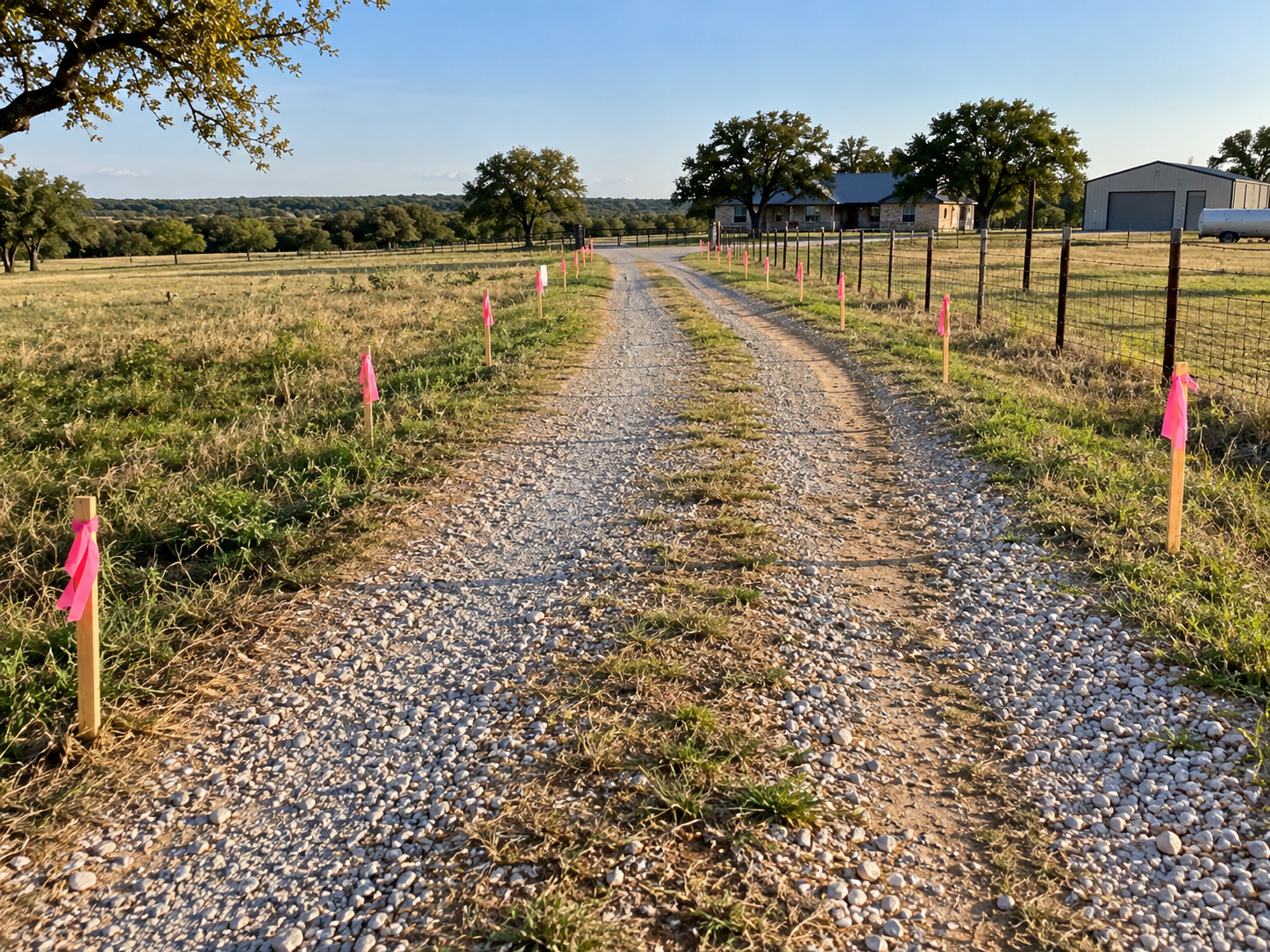
Even when a recorded easement exists, there is another question worth asking:
Does the driveway you are actually using sit inside the legal easement corridor?
A gravel driveway can shift over time.
A curve may be widened. Owners may drive around a muddy section. A culvert may be relocated. Trees grow, drainage patterns change, and the actual traveled path may gradually move.
That means the recorded easement can be in one location while part of the physical driveway has drifted somewhere else.
This is very similar to the issue I discussed in Is That Fence Really the Property Line?.
A fence can look like the boundary without necessarily being the surveyed boundary.
A driveway can create the same kind of assumption.
What you see on the ground may not tell the entire legal story.
This is where a current survey can become particularly valuable, especially if access is important to the buyer’s plans.
Title and Financing Can Bring the Issue to the Surface
Sometimes the access question does not arise until the title commitment arrives.
The title documents may reveal a recorded access easement, exceptions affecting that easement, or a lack of clear documentation supporting the driveway the buyer has been using.
Title insurance coverage depends on the actual commitment and final policy, so buyers should review access-related exceptions rather than assuming that every driveway issue will automatically be covered.
Financing can add another layer.
Under HUD’s current FHA Single Family Housing Policy Handbook, a property must have adequate vehicular and pedestrian access from a public or private street. For private streets and shared driveways, FHA provides for access protected through a permanent recorded easement, ownership interest, or certain HOA arrangements.
Other loan programs and individual lenders may have different requirements.
The broader point is that a driveway can work perfectly well in everyday life and still create questions during underwriting.
Being able to drive to the property and being able to document the property's access rights are not necessarily the same thing.
A Shared Driveway Creates Another Question: Who Maintains It?
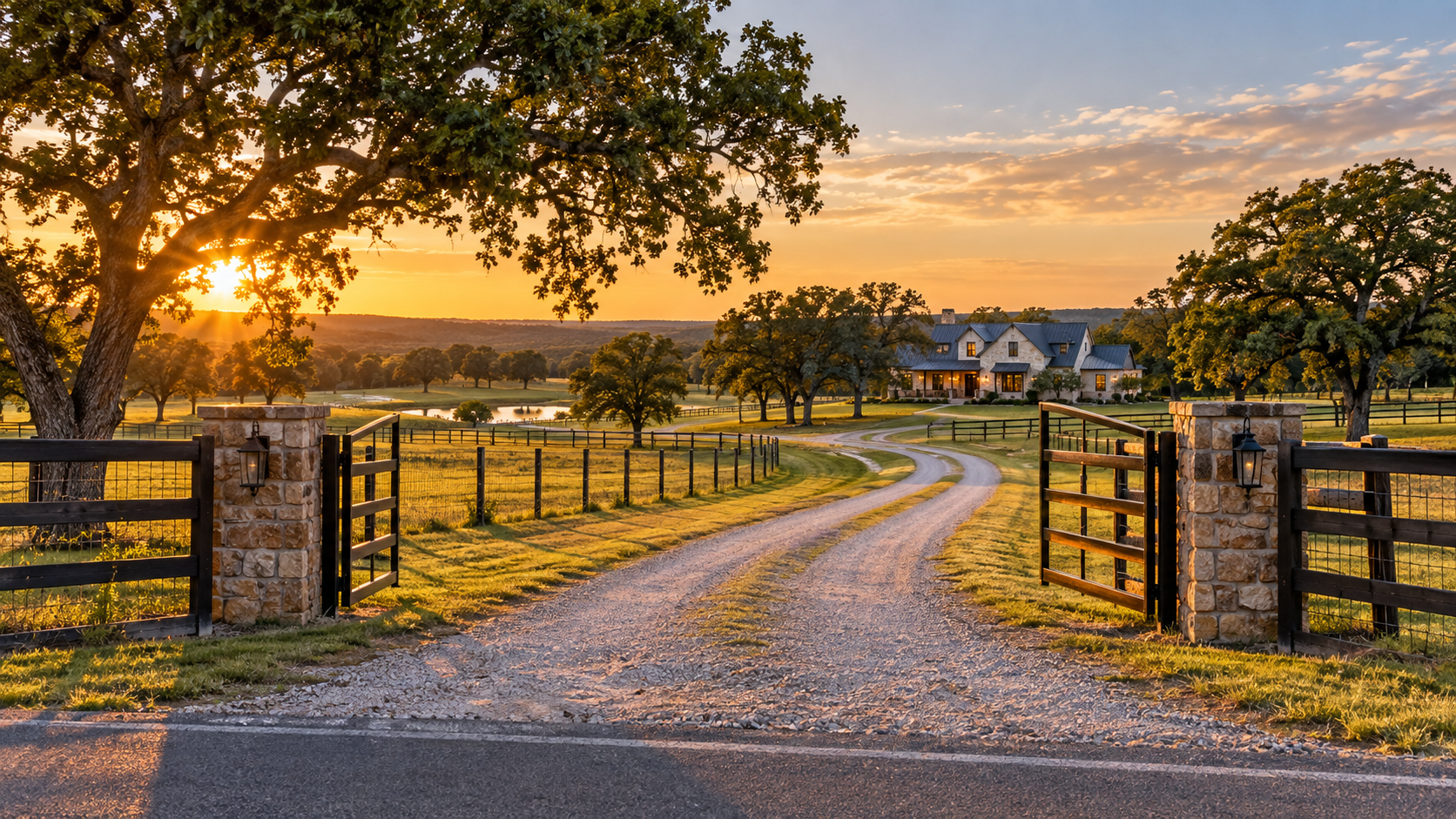
Legal access tells you whether you have a right to use the road.
It does not necessarily tell you who is responsible for maintaining it.
Imagine three homes sharing a 1,000-foot gravel driveway.
Everyone has access.
Then a storm washes out the culvert.
Who pays?
Perhaps the owners have a recorded maintenance agreement specifying how costs are divided. Maybe everyone has historically chipped in equally. Or perhaps one owner has always maintained the road and nobody has ever documented the arrangement.
That may work until the repair involves thousands of dollars.
A maintenance agreement is not the same issue as the easement itself, but understanding both can help a buyer know what ownership will realistically look like.
What Should an Oklahoma Acreage Buyer Investigate?
The current Oklahoma Real Estate Commission Land With or Without Dwelling contract includes easements among the property-use matters a buyer may investigate and also contains provisions addressing surveys and title review.
That is important because access issues are much easier to investigate while you are still in the transaction than after you own the property.
For a property with a private road, shared driveway, or access across another tract, I would want to know:
Is there a recorded access easement?
What property benefits from it?
What property does it cross?
What does the easement actually allow?
How wide is the legal easement?
Does the physical driveway sit within it?
Does it include utilities or only roadway access?
Is there a road-maintenance agreement?
Are there gates or restrictions affecting use?
Does the title commitment contain access-related exceptions?
Does the buyer’s lender have specific access requirements?
If no clear legal access can be found, should an Oklahoma real estate attorney review the situation before closing?
The purpose is not to make every shared driveway seem risky.
It is to distinguish a properly documented access arrangement from one that has simply worked informally so far.
Frequently Asked Questions About Oklahoma Driveway Easements
Do I need an easement if my driveway crosses my neighbor’s property?
You need to understand what legal right allows the property to cross that land. A recorded easement is one common source of access rights, but Oklahoma law recognizes other forms of access under qualifying circumstances.
Can my neighbor block a driveway I have used for years?
It depends on the legal basis for your use. A recorded easement is different from permission a neighbor has voluntarily given. As illustrated in Manar v. Wesson, permissive use does not automatically become a prescriptive easement merely because it continues for many years.
What is an easement by necessity in Oklahoma?
A common-law easement by necessity generally involves property that was once under common ownership and became separated in a way that created necessary access. Oklahoma also has a separate statutory private-way-of-necessity process under Title 27, Section 6.
Can using a driveway for years create an easement?
Potentially, but time alone is not enough. The circumstances surrounding the use matter, particularly whether it was adverse or simply permitted by the adjoining owner.
Can a shared driveway affect financing?
It can. Requirements vary by lender and loan program. FHA, for example, has specific standards concerning adequate access and private streets or shared driveways in its Single Family Housing Policy Handbook.
The Driveway Is More Than Gravel
Most acreage buyers naturally focus on the house, pasture, trees, shop, barn, and views.
The driveway rarely feels like the complicated part.
But when reaching the property requires crossing land belonging to someone else, I would ask more than:
“Can I drive down this road?”
I would also ask:
“What gives this property the legal right to keep using it?”
Sometimes the answer is simple. There is a clear recorded easement, the driveway sits where it should, and the access arrangement has been properly documented.
Other times the answer is:
“The neighbor has always allowed it.”
That is when I would want to investigate further before closing.
Because when you buy acreage, you are not just buying the land you can see.
You are also relying on the rights that allow you to reach it.
And sometimes the driveway that leads you home is exactly where the deeper due-diligence questions begin.
This same principle applies to other assumptions acreage buyers make. A fence is not automatically the property boundary, which I explain in Is That Fence Really the Property Line?. And a property advertised with no HOA may still have other restrictions affecting how the land can be used, as discussed in The Listing Said “No HOA.” So Why Couldn’t They Build the Shop?.
This article is for general educational purposes only and does not constitute legal, title, surveying, lending, or financial advice. Easements, access rights, prescriptive claims, private ways of necessity, title issues, and financing requirements depend on the specific facts, documents, and property involved. Buyers and property owners should consult appropriately licensed Oklahoma professionals when evaluating these matters.
